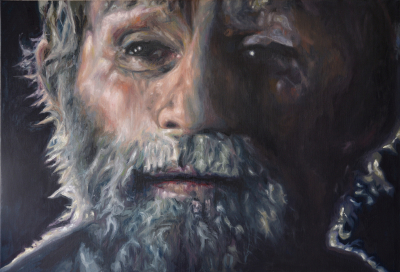
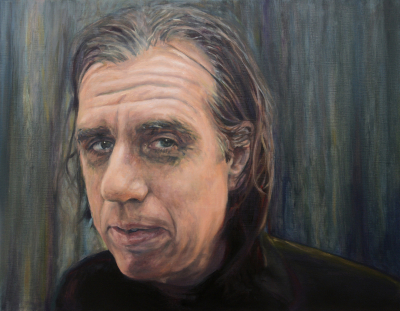
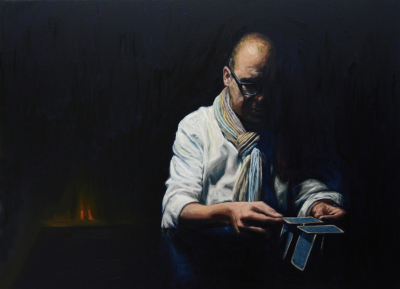
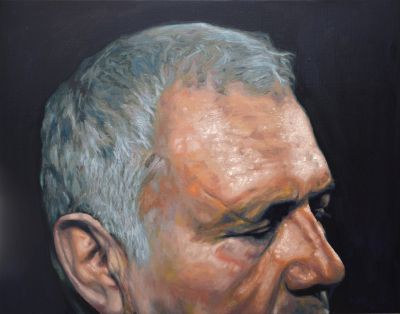
Out of the serie: Portraits 2014-2015
This Serie consists of 20 works
An encounter with himself and his own, Willem Elias
More than a year ago, I received an unexpected email from artist Peter Weidenbaum, with the words 'The Philosopher' in the title bar. On opening this message, I was confronted with my own mug. The title of the work was neither a parody, like Tuymans' 'The Belgian Politician', nor an elevation to the very small group of philosophers that Flanders is poor. Experts in philosophy are numerous, but 'being a philosopher' is reserved for the French and Germans and the occasional Anglo-Saxon. The Dutch-speaking region has to make do in history with Spinoza; Denmark with Kierkegaard; the Greeks with the memory of a great past.
For Weidenbaum, the term 'philosopher' refers only to a kind of person, namely the one who is able to order the world in his head and takes the time to do so: the one who transforms life's unrest into resignation. I can live with that interpretation of the friend of wisdom. But can I also live with the work? Sure. A state portrait it is not, but that is not necessary for anything either. It is a reflection from which Narcissus would flee. And that makes it beautiful, ethically that is - aesthetically one speaks of powerful. It is like a mirror in which one recognises oneself. Not on the basis of external features, but through the suggestion of the traces of life: it shows you the inside.
As diverse as the personalities and their lives are: The Survivor, The Painter, The Mother, The Architect, The Genius, The Psychiatrist,... These names and the atmosphere of the works are reminiscent of the (very influential) master photographer August Sander, who had the hubristic idea of depicting an almost anthropological typology of 20th-century man. By the way, by attaching a time period to it, it did not get a blood-and-butter scent, much to the regret of the Nazi ideologues with whom he took issue. There was no hierarchy in it either, instead he emphasised diversity in unity. Something similar can be found with Peter Weidenbaum. His characters are universal and also so particular at the same time. The remarkable psychiatrist Dirk De Wachter, who carries the suffering of his patients in the bags under his eyes. The 'actor of actors' Julien Schoenaerts, who became more Socrates than the I-know-that-I-don't-know sage himself. The architect reflecting on the fragility of his profession by playing with houses of cards. Paul Gijsemans remodelled his house and thus became 'the' architect. The mother of all times, sculpted by worry, but still his own. The painter himself then, as a self-portrait with eyes closed, as in René Magritte's most famous photograph. Are artists sight-blind, because they do not follow reality? Or are they blind seers, because they create new realities, like signs on the wall?