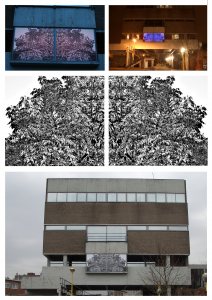
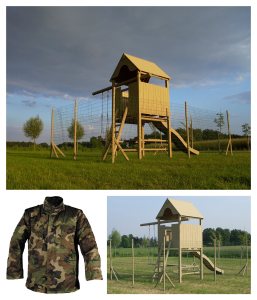
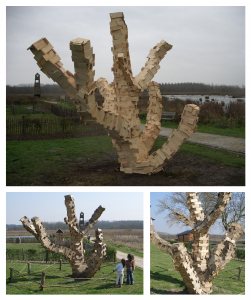
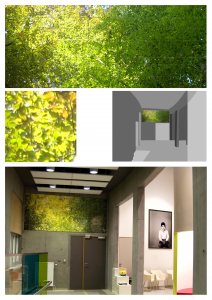
Out of the serie: Art Integrations in Public Space 2006-2014
Landscape as Intervention
In his art integrations in public space, Peter Weidenbaum explores the relationship between nature, architecture, and human experience. His interventions often originate from elements of the natural environment—landscapes, trees, forest structures—which he translates into permanent artworks that are closely interwoven with their architectural context. In his work, nature does not appear as illustration or decoration, but as a mental space that is re-experienced within the built environment.
Weidenbaum approaches architecture not merely as a support for an artwork, but as an active partner in dialogue. Walls, passageways, façades, and openings for light are integrated into the image, allowing the artwork to become part of the user’s everyday experience. Through the use of perspective, scale, light, and material, a dialogue emerges between inside and outside, between the urbanized environment and a memory of openness and calm.
His art integrations often function as landmarks or moments of stillness, particularly in contexts where care, education, or public circulation play a central role. They invite slowing down and attention, offering space for reflection within the everyday functioning of a place. Light plays a crucial role in this process: natural and artificial light enhance the spatial impact of the work and allow it to evolve with the time of day or the changing seasons.
By fragmenting, recomposing, and embedding images of nature within architecture, Weidenbaum creates a shift in perception. The viewer is invited to experience the space differently and to become aware of the interaction between environment, time, and inner experience. In this way, his art integrations acquire a social and human dimension: they open up a space for calm, orientation, and renewed attention within the public realm.